.png)
The Control Paradox: How Letting Go Gives You More Control
- Jamie Cartelami
- Mar 10
- 5 min read

Part 2 of The Psychology of Delegation Series
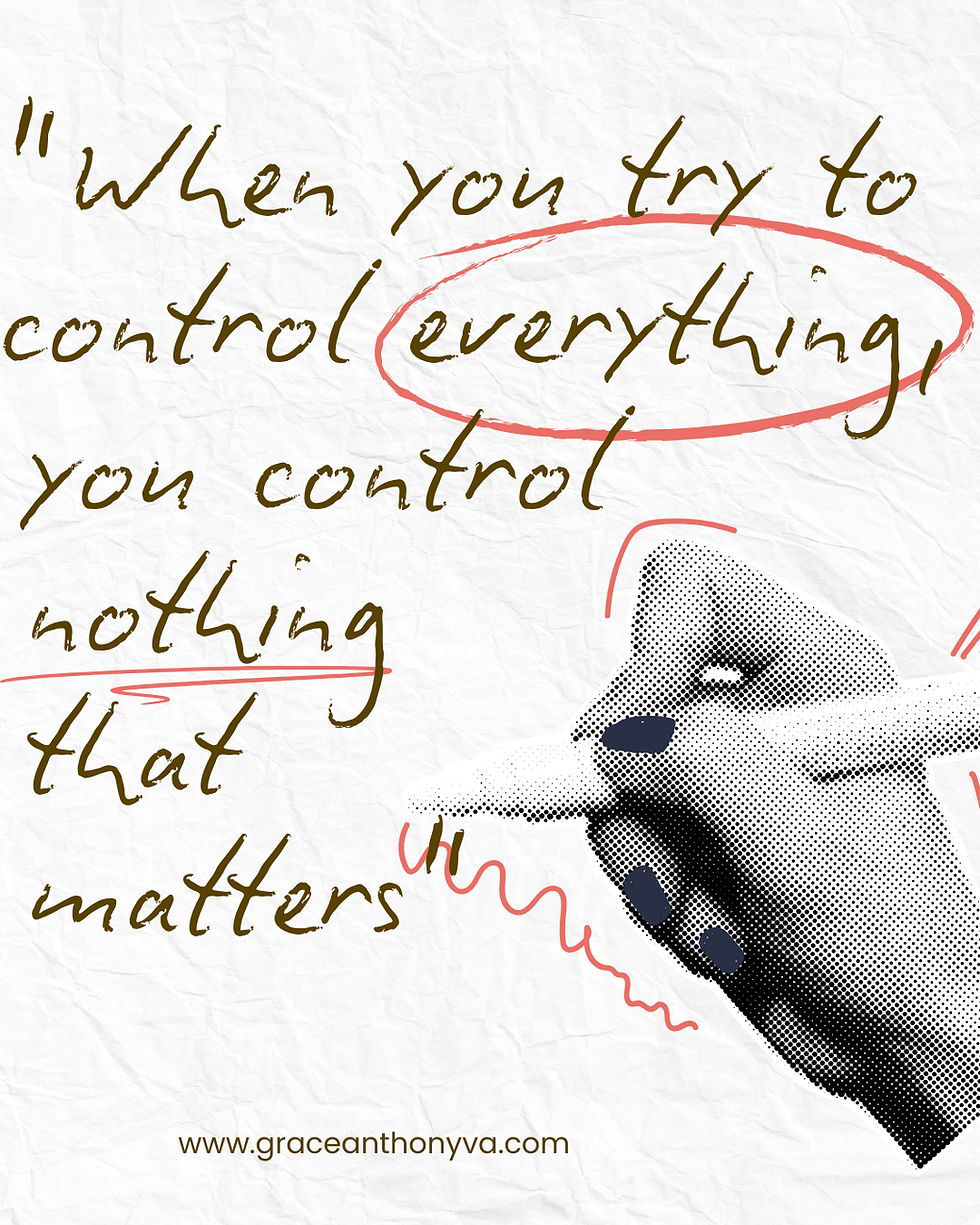
The most common reason executives give for avoiding delegation? "I need to stay in control."
It makes perfect sense. You built your success by maintaining high standards, catching problems early, and ensuring quality outcomes. Control feels like the foundation of everything you've accomplished.
But here's the paradox that took me years to understand: The tighter you grip control, the less control you actually have.
And conversely, strategic letting go—what I call intentional delegation control—actually increases your ability to direct outcomes and influence results.
The Illusion of Total Control
Let's be honest about what "staying in control" really means in most businesses:
You personally review every email before it goes out.
You approve every expense, no matter how small.
You attend every meeting, make every decision, handle every client issue personally.
This feels like control. It's actually the opposite.
Real control means influencing outcomes.
When you're buried in operational details, you lose the perspective needed to steer direction. When you're reviewing travel arrangements, you're not reviewing strategy.
The executive who personally handles calendar management isn't controlling their business—they're letting their business control them.
What Delegation Control Actually Looks Like
Effective delegation control isn't about giving up oversight. It's about designing systems that give you better oversight with less personal involvement.
Instead of: Personally reviewing every client email
Control through delegation: Creating email templates, approval processes, and quality standards that ensure consistent communication without your minute-by-minute involvement
Instead of: Attending every team meeting
Control through delegation: Establishing meeting protocols, requiring written updates, and reviewing outcomes rather than managing process
Instead of: Making every vendor decision
Control through delegation: Setting spending authority levels, vendor criteria, and approval workflows that maintain standards while freeing your time
You're not losing control—you're building control into your systems instead of your personal time.
The Bandwidth Problem
Here's what I learned the hard way: Your personal bandwidth is finite. Your business's needs are not.
When you try to maintain personal control over everything, you create bottlenecks. Projects wait for your approval. Decisions get delayed until you're available. Opportunities are missed because everything flows through you.
This isn't control—it's constraint.
The control paradox in action:
The consultant who insists on writing every proposal personally can only pursue one opportunity at a time
The CEO who approves every expense under $500 spends 5 hours weekly on decisions that don't require their expertise
The business owner who handles all client communication becomes the single point of failure for customer satisfaction
In each case, the attempt to maintain control actually reduces their ability to influence bigger outcomes.
Building Systems That Scale Your Control
The solution isn't to abandon oversight—it's to build oversight into your processes instead of your personal schedule.
1. Standards Instead of Personal Review
Old approach: Review every deliverable before it goes to clients
New approach: Create quality standards, provide examples of excellence, and spot-check 20% of output
Result: Same quality outcomes, 80% less of your time required
2. Exception Reporting Instead of Constant Updates
Old approach: Daily status meetings with every team member
New approach: Weekly written updates highlighting progress, problems, and priorities
Result: Better information flow, fewer interruptions, documented progress
3. Authority Levels Instead of Personal Approval
Old approach: Approve every decision above $100
New approach: Set authority levels based on role and track patterns in monthly reviews
Result: Faster decisions, maintained oversight, team empowerment
The Trust Equation for Control
The biggest barrier to delegation control isn't operational—it's emotional.
"If I don't control it directly, how do I know it will be done right?"
This question reveals the real issue: Control through delegation requires trust, and trust requires evidence.
Here's how to build that evidence systematically:
Phase 1: Controlled Testing (Weeks 1-2)
Delegate low-stakes tasks with clear deadlines
Provide detailed instructions and examples
Review 100% of output and provide feedback
Build evidence of competence on small things
Phase 2: Guided Independence (Weeks 3-4)
Increase task complexity and reduce instruction detail
Review 50% of output, focusing on pattern recognition
Give feedback on process, not just outcomes
Start developing judgment, not just execution
Phase 3: Systematic Oversight (Month 2+)
Delegate higher-stakes work with outcome targets
Review 20% of output and exception reports
Focus on results and system improvements
Build confidence through consistent performance
The Control You Actually Want
When business owners say they "need control," what they usually mean is:
"I need to know that important things will happen reliably, at the quality level I expect, without constant stress about what might be falling through the cracks."
That's not about personal involvement in every decision. That's about predictable systems that produce predictable results.
The control you actually want:
Confidence that deadlines will be met
Quality outcomes without constant supervision
Early warning when problems arise
Ability to focus on strategic priorities
Scalable processes that work without you
None of this requires you to personally handle operational tasks.
When Letting Go Increases Control
The counterintuitive truth: Strategic delegation actually gives you more control over what matters most.
Example 1: A law firm partner who delegated case file management to a skilled assistant gained 8 hours weekly to focus on client relationships and business development. Revenue increased 30% because they could pursue larger cases and better clients.
Example 2: A consultant who handed off proposal writing (with templates and guidelines) went from managing 3 clients to 7 clients at higher rates. Income doubled while working fewer hours.
Example 3: A nonprofit executive who delegated event planning could focus on major donor relationships. Funding increased 50% while events ran more smoothly than when she managed them personally.
In each case, letting go of operational control increased their ability to control strategic outcomes.
The Control Mindset Shift
Traditional control thinking: "I must personally oversee everything important."
Delegation control thinking: "I must ensure systems exist to oversee everything important."
The difference is profound:
Instead of personal involvement, systematic involvement
Instead of micromanaging people, designing processes
Instead of being irreplaceable, making yourself strategic
Instead of controlling tasks, controlling outcomes
Practical Steps to Build Delegation Control
Week 1: Identify three tasks you currently handle that don't require your unique expertise
Week 2: Document exactly how you do these tasks—not just what to do, but why you do it that way
Week 3: Create quality standards and examples for each task
Week 4: Test delegation with one low-stakes task, maintaining close oversight
Month 2: Gradually reduce oversight while tracking outcomes and building confidence
Month 3: Scale successful processes to additional tasks and team members
The Freedom of True Control
Here's what delegation control ultimately creates: The freedom to focus on work that only you can do.
When systems handle operational excellence, you can focus on:
Strategic planning and vision
Key relationship management
Business development and growth
Innovation and improvement
Team development and leadership
This isn't losing control—this is gaining control over what actually determines your success.
The executives who master delegation control don't work fewer hours because they're lazy. They work on different things because they're strategic.
Your Control, Amplified
The control paradox resolves like this: You can't control everything personally, but you can control the systems that control everything.
When you try to maintain personal control over all details, you lose control over strategic direction.
When you build control into your systems and delegate operational oversight, you gain control over outcomes without sacrificing your time to process.
The question isn't whether you'll give up control. It's whether you'll trade operational control for strategic control.
One constrains your business to your personal capacity. The other scales your influence without scaling your workload.
The most successful executives aren't those who control everything personally—they're those who've built systems that give them the control they actually need while freeing them to focus on what only they can do.
What would you do with that freedom?
Next Tuesday: "Perfectionism vs. Excellence: Finding the Balance"—exploring why perfectionist tendencies often prevent perfect outcomes.


Comments